
No. 20 International law · Antarctica
Who governs Antarctica?
How Antarctica is governed under the Antarctic Treaty and its later instruments, and three current pressures on that system: Russian seismic surveys, China's growing presence and stalled marine protection.
Nicolas Centorame · 10 November 2026 · 10 min read
Key judgments
- The ban on mineral resource activities in the 1991 Madrid Protocol has no end date. From 2048 any Consultative Party may request a review conference, but lifting the ban would still require a binding mining regime and demanding majorities.
- The figure of 511 billion barrels attributed to Russian surveys is an unverified estimate of hydrocarbon potential, reported as about 70 billion tonnes. It says nothing about recoverable or commercial reserves.
- The more immediate strain lies in the consensus rule: in the marine conservation commission, Russia and China have repeatedly declined to support new protected areas, and only two exist.
- Growing national presence, including China's fifth station opened in 2024, is consistent with states positioning for a future debate, but public evidence of treaty breaches is thin.
In numbers
In brief
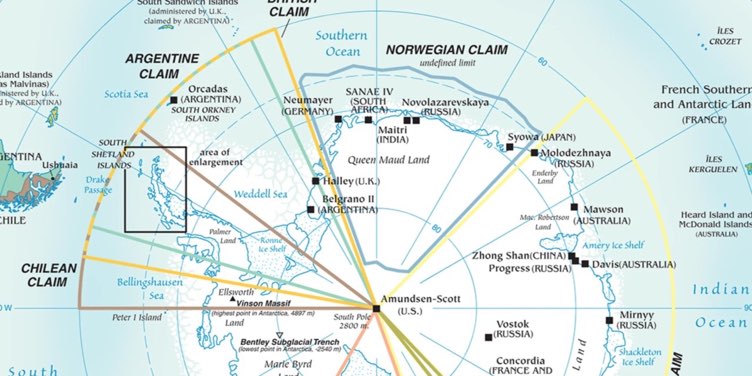
Signed in Washington in 1959 by twelve states and in force since 1961, the Antarctic Treaty reserves the continent for peaceful purposes, opens every station to inspection and, under Article IV, sets the territorial claims of seven states aside without renouncing them.
The report explains what the year 2048 does and does not change for the mining ban, traces the widely reported figure of 511 billion barrels to an unverified Russian survey estimate, and follows China's growing presence.
Its main finding is that the pressure falls on the consensus rule, which protects the mining ban but also blocks new marine protected areas, fishing limits and new members' voting rights.
Key terms
Abeyance
The state of a claim or right that is suspended without being given up. Under Article IV of the Antarctic Treaty, the territorial claims of Argentina, Australia, Chile, France, New Zealand, Norway and the United Kingdom are held in abeyance: activities while the treaty is in force can neither support nor deny a claim, and no new claim or enlargement of an existing claim may be asserted.
Antarctic Treaty, Article IV
Antarctic Treaty
The treaty signed in Washington on 1 December 1959 by the twelve states whose scientists had been active in Antarctica during the International Geophysical Year, in force since 1961. It reserves the continent for peaceful purposes, prohibits measures of a military nature, guarantees freedom of scientific research and opens every station to inspection; its Article IV sets territorial claims aside without renouncing them. In October 2026 it had 58 parties, Switzerland among them since 1990.
Secretariat of the Antarctic Treaty
CCAMLR Commission for the Conservation of Antarctic Marine Living Resources
The commission, based in Hobart, Australia, that manages fishing and conservation in the Southern Ocean under a convention of 1980, in force since 1982. It decides by consensus, so a single member can block a measure. It has designated two marine protected areas, the South Orkney Islands southern shelf in 2009 and the Ross Sea region in 2016, while proposals for East Antarctica, the Weddell Sea and the western Antarctic Peninsula remain under consideration.
CCAMLR
Consultative Party
A party to the Antarctic Treaty with the right to take part in decisions at the Antarctic Treaty Consultative Meeting (ATCM). The twelve original signatories hold the status permanently; states that accede later gain it only while they demonstrate substantial research activity, such as setting up a station or sending a scientific expedition. In October 2026, 29 of the 58 parties were Consultative Parties; Switzerland is a Non-Consultative Party, which may attend meetings but has no vote.
Antarctic Treaty, Article IX
Madrid Protocol Protocol on Environmental Protection to the Antarctic Treaty
The protocol signed in Madrid on 4 October 1991 and in force since 1998 that designates Antarctica a natural reserve devoted to peace and science. Its Article 7 prohibits any activity relating to mineral resources other than scientific research. The ban has no end date: from 2048 any Consultative Party may request a review conference, but lifting it requires demanding majorities and a binding legal regime on mineral resource activities in force.
Protocol on Environmental Protection to the Antarctic Treaty, Articles 7 and 25
Marine protected area
An area of sea in which fishing and other activities are restricted or prohibited in order to conserve ecosystems and species. Coastal states designate them in their own waters; beyond national jurisdiction they need agreement among states, as in the Southern Ocean, where CCAMLR has designated two such areas and further proposals await consensus.
IUCN