
No. 18 Security · Suez Canal, Egypt
Did the Suez crisis end Britain and France as world powers?
Seventy years after the Suez war, how far the crisis ended Britain and France as world powers: their shares of world output, sterling, the loss of empire after 1956, and how the United States and the Soviet Union took the lead in the Middle East.
Yair Segal, Nicolas Centorame · 29 October 2026 · 13 min read
Key judgments
- Suez exposed Britain's financial dependence on the United States: IMF and US records show that support for sterling was made conditional on withdrawal from Egypt.
- The largest colonial losses came before Suez, India for Britain in 1947 and Indochina for France in 1954. Within about a decade of 1956 both gave up most of their remaining colonies; how far Suez caused this is disputed among historians.
- Britain and France keep permanent seats on the UN Security Council and nuclear forces, while their shares of world output fell from about 5.7 and 4.0 per cent in 1956 to about 2 per cent each in 2022.
- Suez ended military action outside Europe against American wishes and made an older economic decline visible, without by itself ending either state's global role.
In numbers
In brief
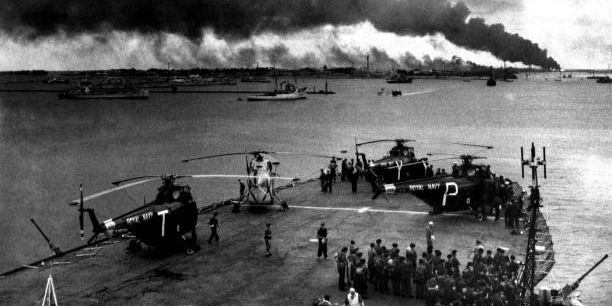
On 29 October 1956 Israeli forces attacked in Sinai under a plan agreed with Britain and France at Sèvres. Anglo-French bombing and landings followed, and by 22 December, under American financial pressure and repeated UN calls, the last British and French troops had left Egypt.
The report tests the view that Suez ended both states as world powers against four measures: share of world output, the international role of the currency, the ability to use force outside Europe without American consent, and formal rank.
Britain moved closer to Washington and later withdrew from east of Suez; France turned towards Europe and its own nuclear force. Historians disagree on whether 1956 was the turning point or the moment an older decline became visible.
Key terms
Decolonisation
The process by which colonies and other dependent territories became independent states, concentrated between 1945 and the mid-1970s, when most of Asia and Africa gained independence. In <dfn id="resolution-1514">resolution 1514</dfn> of December 1960, the UN General Assembly declared the right of colonial peoples to independence.
United Nations
Suez crisis
The war of 1956 in which Israel, Britain and France attacked Egypt after President Nasser nationalised the Suez Canal Company in July; Israel cited raids from Gaza and Egypt's closure of the Straits of Tiran to its shipping. Under financial pressure from the United States, including a run on sterling, and threats from the Soviet Union, London and Paris accepted a ceasefire in November, an outcome widely seen as marking the end of their imperial power.
Suez Canal
A sea-level canal across Egypt between Port Said on the Mediterranean and Suez on the Red Sea, opened in 1869, which spares ships between Europe and Asia the voyage around Africa. Egypt's nationalisation of the canal company in July 1956 led to the Suez crisis; the grounding of the Ever Given blocked it for six days in March 2021.
Suez Canal Authority
IMF International Monetary Fund
The institution created at Bretton Woods in 1944 and based in Washington that monitors its members' economic policies and lends to countries with balance of payments difficulties, usually on condition of policy reforms. Voting power follows quotas, which gives the United States a veto over decisions needing an 85 per cent majority; by convention its managing director is European.
Sterling area
The group of countries, mostly in the British Empire and Commonwealth, that pegged their currencies to sterling and held their reserves in London, formalised at the outbreak of war in 1939. It kept sterling the second reserve currency after the war, but repeated runs, including during the Suez crisis of 1956, eroded it until it was largely dismantled in 1972.
East of Suez
The British military presence in the Persian Gulf, the Indian Ocean and Southeast Asia, which the government of Harold Wilson announced in January 1968 it would withdraw, a withdrawal largely completed by 1971. It ended Britain's role as the main outside power in the Gulf and is often taken as the end of its position as a global military power.
Protocol of Sèvres
The secret agreement reached at Sèvres, near Paris, in October 1956 by Britain, France and Israel, under which Israel would attack Egypt in Sinai and Britain and France would then intervene, ostensibly to separate the combatants and protect the Suez Canal. It set the course of the Suez war, and British ministers long denied that any such collusion had taken place.