
No. 17 Security · Bern, Switzerland
The Swiss bomb that never was: Switzerland's nuclear weapons programme, 1945 to 1988
From a colonel's letter nine days after Hiroshima to the dissolution of the last committee in 1988: what official records show about Switzerland's plans, costs and votes on nuclear weapons, and why the programme never went beyond studies.
Yair Segal · 28 October 2026 · 10 min read
Key judgments
- In 1958 the Federal Council publicly declared that the army should have the most effective weapons, including nuclear weapons, and never formally withdrew that aim before signing the Non-Proliferation Treaty.
- Military planners costed and specified a Swiss arsenal in 1963 and 1964, but no weapon was built, tested or acquired, and no enrichment plant was funded.
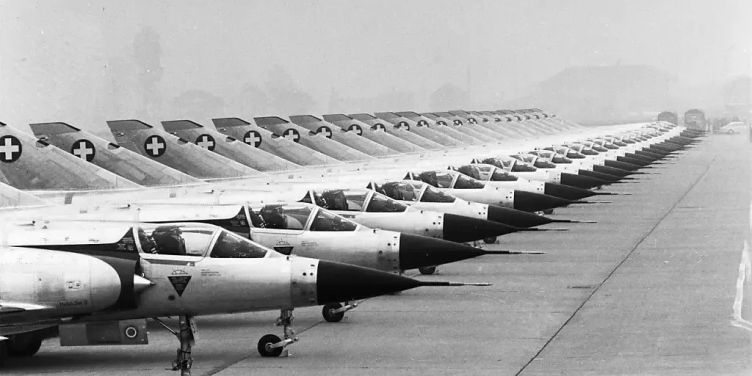
- Budget politics, above all the 1964 Mirage procurement scandal, did more to slow the programme than foreign pressure or public opposition.
- The Swiss case shows how a technically capable, neutral state can treat a nuclear option as insurance and let it lapse once the non-proliferation regime looks durable.
In numbers
In brief
Nine days after Hiroshima a Swiss colonel asked Bern to study the atomic bomb. A commission under the physicist Paul Scherrer received confidential instructions in 1946, and after the Hungarian uprising of 1956 officers pressed for nuclear arms of their own.
Planners costed an arsenal and studied test sites in caverns, while voters twice rejected limits on nuclear arms. The Mirage cost overrun of 1964 cut the aircraft order and left the programme without the money it needed.
Switzerland signed the Non-Proliferation Treaty in 1969 and ratified it in 1977. A small working committee kept the knowledge of a threshold state until it was dissolved at the end of 1988.
Key terms
Non-Proliferation Treaty Treaty on the Non-Proliferation of Nuclear Weapons (NPT)
Treaty opened for signature in 1968 and in force since 1970. It recognises five nuclear-weapon states, those that had built and exploded a nuclear device before 1 January 1967: the United States, Russia, the United Kingdom, France and China. The other parties undertake not to acquire nuclear weapons, all parties may use nuclear energy for peaceful purposes, and the nuclear-weapon states undertake to pursue negotiations on disarmament. Switzerland signed in 1969 and ratified in 1977.
UN Office for Disarmament Affairs
Treaty on the Prohibition of Nuclear Weapons TPNW
Treaty adopted at the United Nations in 2017 and in force since January 2021. It prohibits its parties from developing, testing, producing, possessing, using or threatening to use nuclear weapons. None of the states that have nuclear weapons has joined it, and Switzerland is not a party.
UN Office for Disarmament Affairs
Treaty on the Prohibition of Nuclear Weapons in the glossary
Cold War
The rivalry between the United States and its allies and the Soviet Union and its allies, from the late 1940s until the Soviet Union dissolved in 1991. The two never fought each other directly; competition ran through an arms race, alliances, proxy wars, propaganda and the race into space.
Fissile material
Material that can sustain the nuclear chain reaction needed for a bomb, in practice highly enriched uranium and plutonium. Uranium enriched to 20 per cent or more of the isotope uranium-235 counts as highly enriched, and weapons usually use about 90 per cent; plutonium is produced in reactors and separated from spent fuel by reprocessing.
International Atomic Energy Agency (IAEA)
Neutrality
The legal status of a state that does not take part in a war between other states. Its rights and duties are codified in the Hague Conventions of 1907: belligerents must respect its territory, and it must treat them impartially and not supply them with troops or arms from state stocks. Swiss neutrality was recognised by the European powers in 1815.
Hague Conventions V and XIII (1907)