
No. 16 Security · Bamako, Mali
Private armies, from the East India Company to the Sahel
How states have used private armed force from the East India Company to Russia's deployments in Mali, what is documented about how it is paid for, and how regulation such as the Swiss-led Montreux Document has responded.
Nicolas Centorame · 20 October 2026 · 11 min read
Key judgments
- Official US data show that Defense Department contractors outnumbered US troops in Iraq and Afghanistan for long periods.
- Wagner-linked gold trading to fund the group is documented in the Central African Republic. In Mali, research finds that neither Wagner nor Africa Corps gained access to the gold sector.
- International regulation has grown through non-binding instruments such as the Montreux Document, while the binding 1989 UN Mercenary Convention has few parties and does not address companies directly.
- The shift to a state-controlled Africa Corps makes Russian responsibility easier to attribute, though no visible accountability for abuses has followed.
In numbers
In brief
States have hired private force for centuries. The East India Company raised an army about twice the size of the British Army under a charter Parliament renewed, until the Crown took its territories and forces in 1858.
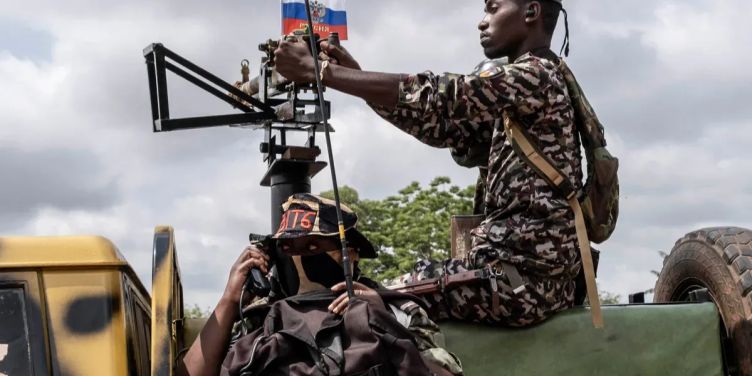
The United States relied on more contractors than troops in Iraq for long stretches. In Africa, Russian fighters first organised as the Wagner Group now operate in Mali as the state-controlled Africa Corps.
The report sets out what is documented about how these deployments are paid for, and how regulation has developed, including the Montreux Document, a Swiss and ICRC initiative of 2008.
Key terms
Montreux Document
An intergovernmental document of 2008, launched by Switzerland and the International Committee of the Red Cross, that restates the obligations of states under existing international law regarding private military and security companies in armed conflict and sets out good practices. It is not legally binding and creates no new obligations.
Swiss FDFA and ICRC
Private military and security company
In the definition of the Montreux Document, a private business that provides military or security services, whatever it calls itself. These services include armed guarding and protection, operating and maintaining weapons systems, detaining prisoners, and advising or training local forces and security personnel.
Montreux Document (2008)
Mercenary
Under Additional Protocol I to the Geneva Conventions, a person recruited to fight in an armed conflict, motivated essentially by private gain and paid substantially more than regular soldiers, who is neither a national of a party nor a member of its forces. All six conditions must be met, so few contractors qualify; a mercenary has no right to prisoner-of-war status.
Additional Protocol I (1977), Article 47
Wagner Group
A Russian private military company, active from 2014 in Ukraine, Syria and African states including Mali, the Central African Republic and Libya, often paid partly in mining concessions. After its leader Yevgeny Prigozhin led a mutiny in June 2023 and died in a plane crash two months later, Russia's defence ministry built up an Africa Corps to take over its role, and it replaced Wagner in Mali in June 2025.
East India Company
The English trading company chartered in 1600 that built its own army and came to rule much of India after its victory at Plassey in 1757. At its height its forces were larger than the British army; after the Indian rebellion of 1857 the Crown took over its territories, and the company was dissolved in 1874.
Sahel
The semi-arid belt south of the Sahara, stretching from Senegal and Mauritania to Sudan and Eritrea. Its central part, Mali, Burkina Faso and Niger, has faced jihadist insurgencies since 2012 and military coups between 2020 and 2023, after which French forces left and Russian forces arrived.
Africa Corps
A Russian military formation under the defence ministry that took over much of the Wagner Group's role in Africa after the death of its founder Yevgeny Prigozhin in 2023. It has deployed to Mali, Burkina Faso and Niger, and replaced Wagner entirely in Mali in June 2025, bringing Russian security support in Africa under direct state control.