
No. 15 Demography · Polish-Belarusian border
People as Pressure: When Moving Human Beings Becomes an Instrument
How states move people to put pressure on a rival or to build a nation, from the Belarus border crisis of 2021 back to the population exchange of 1923 and the Partition of India.
Yair Segal, Nicolas Centorame · 8 October 2026 · 9 min read
Key points
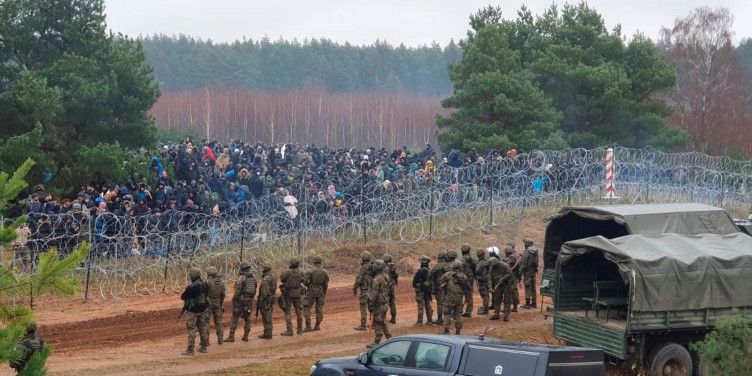
- Some states deliberately channel migrants towards a rival's border, turning the target's own asylum commitments into the point of pressure.
- The report examines Belarus at the borders of Poland, Lithuania and Latvia from 2021, Russia at the Finnish border in 2023, Turkey at the Greek border in 2020 and Morocco at Ceuta in 2021.
- The tactic forces a democracy to choose between its principles and its border control, and the report sets out the case on both sides.
- Earlier population transfers, the Greek-Turkish exchange of 1923 and the Partition of India in 1947, used the movement of people to build nation-states.
In numbers
In brief
Most migration is a byproduct of war, hardship or climate. The report looks at the other kind: movements of people that a state generates or channels on purpose to put pressure on a rival.
It follows the recent cases on the edges of Europe and the responses to them, from fences and exclusion zones to the suspension of asylum claims, and the criticism those responses draw.
It then traces the older use of the same lever, the transfers that sorted populations to match new borders, and argues that many apparently settled ethnic maps are the result of such decisions.
Key terms
Instrumentalised migration
The EU term for a situation in which a third country or a hostile non-state actor encourages or facilitates the movement of people towards the external borders of the Union in order to destabilise the Union or a member state. EU institutions applied it to the movements across the Belarusian border in 2021.
European Commission
Partition of India
The division of British India in August 1947 into two independent states, India and Pakistan, whose eastern wing became Bangladesh in 1971. The new boundary through Punjab and Bengal, drawn by Cyril Radcliffe and published after independence, set off one of the largest migrations of the 20th century, with communal violence that killed hundreds of thousands of people.
Treaty of Lausanne
The peace treaty signed in Lausanne in July 1923 between Turkey and the Allied powers, which replaced the Treaty of Sèvres and fixed most of the borders of modern Turkey. A separate convention signed in Lausanne that January provided for the compulsory exchange of Orthodox Christians living in Turkey and Muslims living in Greece, exempting the Greeks of Istanbul and the Muslims of Western Thrace.
Greek-Turkish population exchange
The compulsory exchange agreed by Greece and Turkey in a convention signed at Lausanne in January 1923, which moved Orthodox Christians from Turkey to Greece and Muslims from Greece to Turkey, defined by religion rather than language. About 1.2 million and 400,000 people respectively were moved, and it became a reference for later forced transfers.