
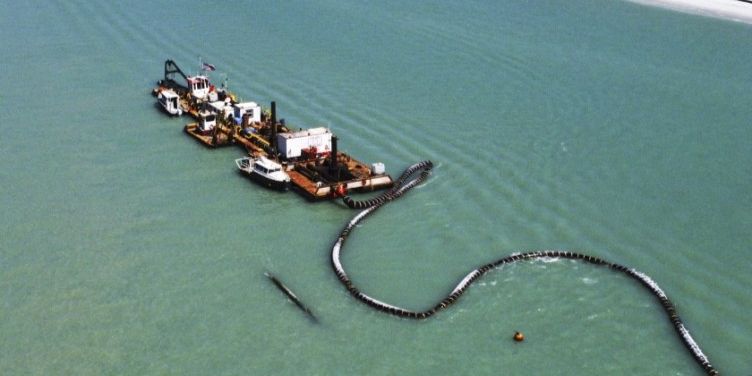
No. 14 Commodities · Riau Islands, Indonesia
The Most-Mined Substance You Never Worry About
Fifty billion tonnes a year, desert sand that cannot be used, islands dredged out of existence, and a trade that is two-thirds illegal.
Nicolas Centorame · 29 September 2026 · 8 min read
Key points
- Desert sand is too smooth and round to bind in concrete; construction needs the angular sand of rivers, lakes and coasts.
- Usable sand is extracted faster than natural processes replace it, and demand has roughly tripled in two decades with urbanisation.
- A large illegal trade has grown around it, with violence against those who investigate it.
- No international body governs sand extraction; UNEP has called for it to be treated as a strategic resource.
In numbers
In brief
After water, sand and gravel are the most extracted materials on Earth. Concrete, glass and reclaimed land all depend on them, and the purest silica sand is also the start of the silicon chain.
Because only water-shaped sand will do, extraction concentrates on rivers and coasts, with lowered water tables, collapsing banks and sinking deltas as a result. Several South-East Asian exporters have banned or restricted sand exports.
The report argues that sand is a scarce resource without a cartel: it is being used up everywhere, with almost no oversight.
Key terms
Aggregates
Sand, gravel and crushed rock used in construction, above all in concrete and asphalt, and as fill for land reclamation. Desert sand is generally unsuitable for concrete because wind erosion leaves its grains too smooth and round to bind well.
UNEP
Land reclamation
The creation of new land from sea, lakes or wetlands, usually by pumping dredged sand onto the site. Singapore has enlarged its land area by about a quarter since independence this way, largely with imported sand, and China used it to build artificial islands in the Spratlys.